Serato Scratch Live (“SSL”) software has immense influence in the
digital vinyl (or “DVS”) world. Digital vinyl systems use traditional DJ
gear (record decks/CDJs and mixers) to control laptop software and thus
digital music files. While nowadays SSL has a strong competitor in
Traktor Scratch, it continues to wield a lot of power and respect – and
by extension, so does Rane, Serato’s official hardware partner.
As well as producing audio interfaces that allow you to use your
traditional DJ mixer with Serato Scratch Live, Rane also produces
digital DJ mixers that do away for the need for an audio interface. Plug
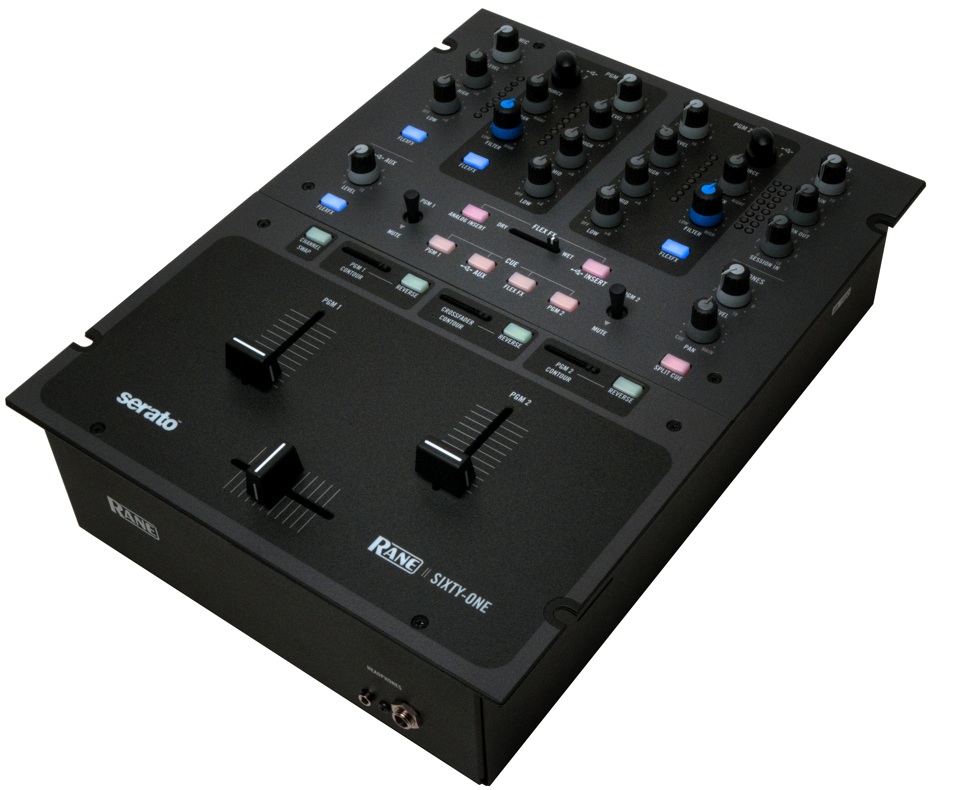
two turntables into a Serato Scratch Live-enabled DJ mixer, such as the
Rane Sixty-One reviewed here today, and you need no extra hardware
apart from your laptop to be able to DJ using software and digital music
files. Let’s take a closer look…
First impressions and setting up
Rane doesn’t produce shoddy gear, and it doesn’t produce cheap gear,
either; on unboxing (and checking the price – a cool US$1,400) it is
clear that the Rane Sixty-One continues the tradition. It’s an
understated mixer, appearing at very first glance like any full-sized
two-channel DJ mixer. It is metal, but not over-heavy, and painted in a
sober grey and black colour scheme. The only flash of colour is added by
the two royal blue and black filter controls.
Rane doesn’t produce shoddy gear, and it doesn’t produce cheap gear, either…
As well as the mixer, the box contains two control records, two
control CDs, a USB cable, an IEC C5 line power cord (or kettle lead, to
us heathens), a quickstart guide, the full printed guide, and a software
CD.
Back to the mixer itself. The front panel contains just the
headphones sockets (1/4″ and 1/8″), and the whole unit sits on four
screwed-in rubber feet.
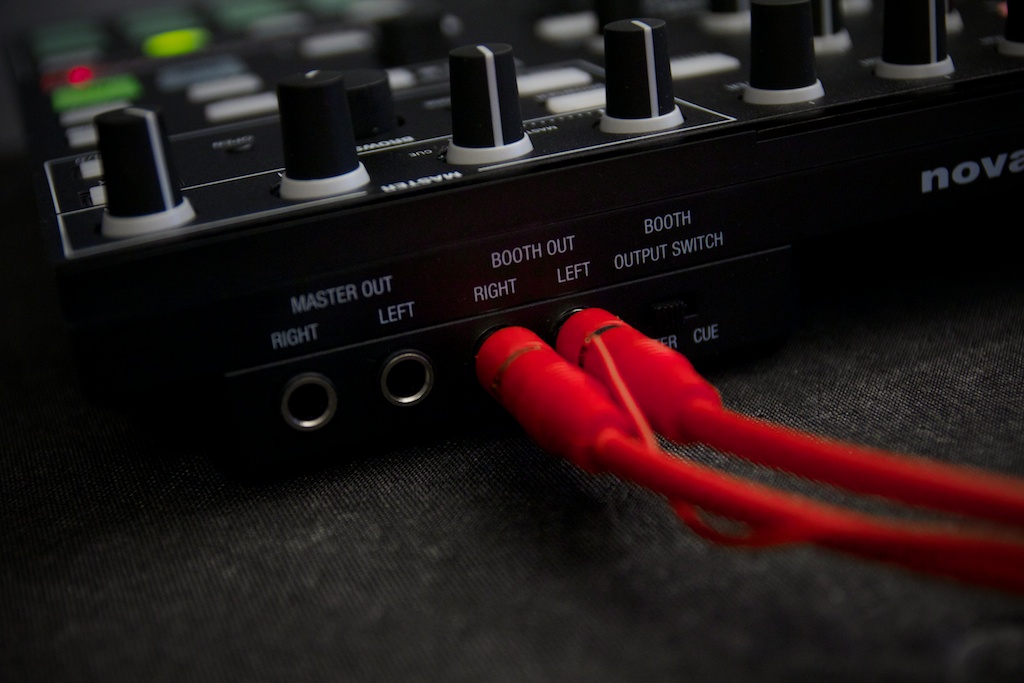
Round the back there are a big, chunky on/off switch and power
socket, the USB for your laptop, TRS 1/4″ balanced outs (no XLRs),
“session” ins and outs (more on these later), the effects loop ins/outs
(again, paired TRS, this time unbalanced). four RCA inputs (switchable
from phono to CD), a mic input (again, switchable mic/line) and a pair
of earthing poles with oversized screw-downs for the deck grounding.
To the top of the mixer. There is a lip around the top edge, and four
bolt holes to allow the unit to be fitted into a permanent DJ set-up,
flush with the surface.
The top plate is in two halves, the bottom half covering the faders, the top half all the other controls.
The faders are magnetic and nicely loose in feel; the magnetic design
means that even if they get dirty and feel a bit dodgy (stuff does get
spilled on mixers, after all), they’ll be more likely to continue to
perform well.
The three controls above the two line faders give away the scratch DJ
pedigree of this mixer; all are squarely aimed at turntablists. Thus
you get a channel swap button, plus fader contour and reverse buttons
for all three faders.
The faders hit full reach before they contact the top plate, stopping
with a pleasing, slightly damped feel that means I doubt anyone is
going to use this mixer carefully keeping the lines at 2/3rds; it
screams to have fine tuning done at the trims and have the lines used
throughout their reach. That’s how I fell into using it, anyway.
The upper half of the top panel contains all the other controls. The
mixer’s two channels (each of which has gain and three-band EQ) have
input selectors for the analogue and digital inputs (more later),
including the requisite thru/USB settings. There are FX send buttons for
both of these main channels, as well as for the microphone channel (two
EQs and a gain) and the AUX (which is a digital AUX designed primarily
to carry the signal from the sample decks).
These are the modern-day equivalent of the sprung toggles we used to use back in the day as cut switches…
True analogue “aux” thru is provided by the session input, which has a
volume in (but no other controls on the input) and a “session out”
level. Rane says this is typically used for hooking multiple mixers
together, but I can see it used more as a true “emergency thru” (session
in) and as a booth monitor (session out), as the output is effectively a
second master out, with its own volume control.
Finally, there are the cue buttons (including an FX cue), the dry/wet
mini-fader for the FX send, and two insert buttons for the effects
(more later on this). Oh, and two small “mute” joysticks: These are the
modern-day equivalent of the sprung toggles we used to use back in the
day as cut switches; move these in any direction from central and they
have the same effect, killing the channel until released, upon which
they spring back to central and the channel’s throughput is restored.
In use
Rane and Serato’s system is like the Apple of the DVS world; it’s
meant to just work, and by and large it does. You install Serato Scratch
Live (it’ll automatically install the correct drivers, Core Audio or
ASIO depending upon whether you’re on Mac or PC, as long as you follow
the instructions and have the hardware plugged in as you run the
installers); calibrate your decks (it’s simple – one-button, basically);
and plug everything in as they say. Then, it all just works. Took me
all of 10 minutes.
The mixer is described by Rane as “dual personality”, and that fits
well, as it is equally at home with analogue and digital sources,
switching seamlessly between the two. That means you can use it in
situations where you have vinyl/CD and digital vinyl DJs playing, or
indeed where you want to mix and match within the same set.
The unit screams usability: the aforementioned smooth faders; hard,
backlit, minimal-movement pushbuttons; and low-resistance panel-bolted
pots all meaning it inspires supreme confidence in use.
The filters are actually hardware effects, and sound customarily
excellent; one curiosity is that you can adjust their resonance, but
only through the SSL software.
The “Flex FX” are also a hardware/software hybrid; you can use the
analogue insert button to send any source that has the “Flex FX” button
pressed (including multiple sources) to the FX bus, so you can add
external hardware effects (such as Pioneer’s new
RMX-1000,
for instance), but also you can send your chosen sources (and that
includes analogue sources) through Serato Scratch Live’s DJ FX by
pressing the USB insert button. Interestingly, you can also do
both, and a schematic in the manual shows you how this all fits together.
Serato Scratch Live’s effects can themselves be daisy-chained into
two sets of three, so overall you have quite some flexibility available
here. However, the eagle-eyed among you will have spotted that there are
no controls at all on the mixer for effects other than the on/off and
wet/dry controls, and the hardware filters. We’ll mull over this
omission in the conclusion.
It sounded truly excellent:smooth, with clarity, warmth, punchy bass and crisp, pleasing highs.
Rane make much of the audio interface spec in this unit (32-bit
floating point, 48kHz), and on test through half-decent studio monitors
it sounded truly excellent: smooth, with clarity, warmth, punchy bass
and crisp, pleasing highs. I wired up an iPhone (via its headphones
socket) through the Session In channel on the Rane to test the emergency
thru capability of the unit, and the iPhone sounded shockingly bad
against the lovely digital audio from the built-in interface on the
Rane.
It’s also worth noting here that the interface can (unlike the
mixer’s SSL predecessor, the TTM-57SL) be used as a six-stereo-record,
four-stereo-playback audio interface for any software when Serato
Scratch Live isn’t running, thanks to a supplied control panel app.
Regarding the interfacing with Serato Scratch Live software, I felt
instantly at home mixing “vinyl” on it, and as a DJ who played on vinyl
for 15 years before “going digital” (and by “going digital” I mean
all-out, switching to controllers, not DVS), it felt completely
authentic. As I alluded to at the start of this section overall it “just
worked” – exactly as expected, with no real surprises.
Conclusion
Very quickly you start to mull over what Serato intends this mixer to
be used for. You see, the TTM-57SL, as Serato’s previous only two-line
Serato Scratch Live mixer, was trying to be everything to everyone, with
effects, loops and so on onboard. This mixer has none of that.
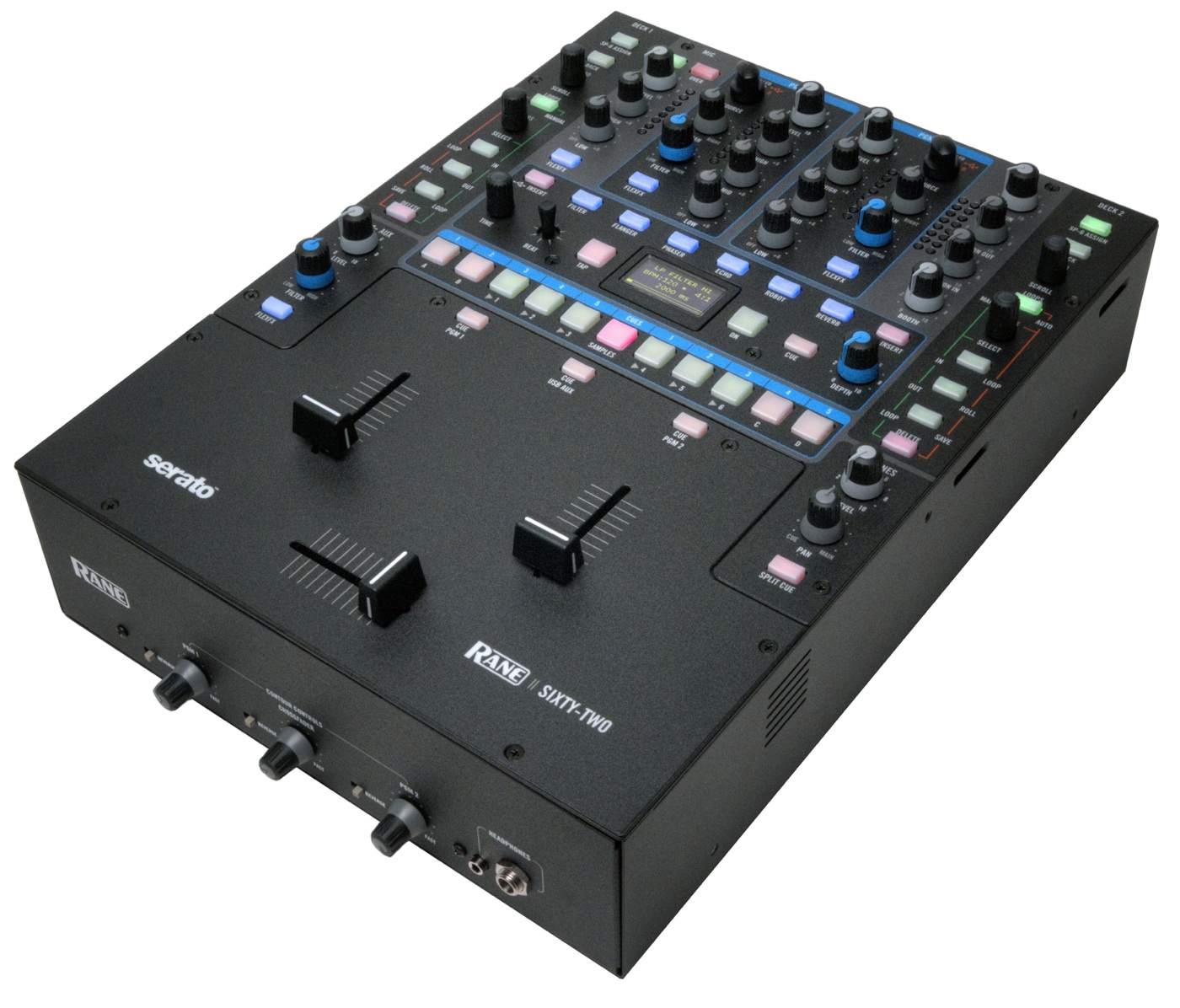
Conversely, the Sixty-Two – released at the same time – is all bells and
whistles. It’s like the company is trying to replace the ’57 with not
one, but two mixers.

.
Here’s what I thing their reasoning is. The Sixty-One, for me, is
designed for hardcore vinyl enthusiasts, who want to incorporate digital
vinyl into their DJing. When Serato Scratch Live is in “absolute” mode,
it is designed to really, truly, emulate real vinyl. The start of the
control record is the start of the MP3; the end of the record, the end
of the MP3. Jog the turntable, the MP3 “jogs”.
Necessarily, therefore, there will be no looping, cue points and so
on DJing like this – because it’s not present on vinyl. For Djing in
this manner, the Sixty-One has exactly what you need – and nothing more.
The Rane Sixty-One provides a simple, elegant, pristine
quality “in” into turntablism, and is particularly suited to the
technology-agnostic DJ
The filter is a nod to the present, granted, and of course you can
switch into relative mode and start introducing some of the bells and
whistles of digital DJing, but don’t expect the Sixty-One to come along
for the ride: You’ll be using your laptop to control the effects, loops
and cues, (or alternatively, you’ll go for an external Midi controller).
The Rane Sixty-One could in this light be seen as a TTM-56S, but with
Serato Scratch Live capability.
The Sixty-Two, however, has built-in effects, cues, loop controls and
so on – it’s more like the ’57, but with the advances that both of
these mixers share over that mixer (better audio interface with the
ability to use it with other applications, USB 2.0, plus easy switching
between analogue and digital, or indeed two laptops in the case of the
Sixty-Two), Between the two models, I believe Serato wants to cover two
distinct customer types, and I wouldn’t be surprised therefore to see
the ’57 phased out.
Which only leaves us with the price, and here’s where things start to
look less rosy. The Sixty-One is priced pretty much the same as the
’57, and features-wise, you’re getting less. Higher spec maybe, but less
overall. You’re frankly paying a hefty premium. (If you were comparing
the ’57 to the Sixty-Two, in many ways its more natural replacement out
of the two, well, the difference is a cool US$600.) You definitely need
to consider whether it is worth the extra over the ’57 for you.
To conclude. The Rane Sixty-One provides a simple, elegant, pristine
quality “in” into turntablism, and is particularly suited to the
technology-agnostic DJ (probably turntablist) who simply wants hardcore
vinyl emulation without any complications. It’s Apple-like in its
implementation of digital vinyl; Rane and Serato have made switching
between real vinyl and control vinyl use a cinch, and have set a new
benchmark for usability here.
It sounds amazing, and the flexibility afforded by its sound
interface makes all kinds of hardware/software permutations possible and
indeed straightforward. But if you want the bells and whistles you may
be expecting from a new Rane mixer having got used to the spec of the
’57, you need to look to the Sixty-Two – and swallow a significant
price jump to boot.


 Serato’s rolling out a brand
new piece of DJ software today – Serato DJ. Fresh on the heels of
updates to ITCH and SSL last week, the introduction of Serato DJ is
designed to fill a professional controllerist DJ gap in the Serato
software lineup. With a feature set that includes real MIDI mapping
utilities, iZotope-developed effects, additional cue points, and a brand
new Pioneer DDJ-SX controller for the software, is Serato DJ ready to
win the hearts of digital DJs?
Serato’s rolling out a brand
new piece of DJ software today – Serato DJ. Fresh on the heels of
updates to ITCH and SSL last week, the introduction of Serato DJ is
designed to fill a professional controllerist DJ gap in the Serato
software lineup. With a feature set that includes real MIDI mapping
utilities, iZotope-developed effects, additional cue points, and a brand
new Pioneer DDJ-SX controller for the software, is Serato DJ ready to
win the hearts of digital DJs?


 Rane
and Serato have worked tightly together for eight years pioneering
practical DVS systems. The TTM57 is definitely showing its age, though,
and has now received a modern update. There are 2 models of mixers: The
Rane 61 and the Rane 62 depending on what your flavor of mixer is.
Rane
and Serato have worked tightly together for eight years pioneering
practical DVS systems. The TTM57 is definitely showing its age, though,
and has now received a modern update. There are 2 models of mixers: The
Rane 61 and the Rane 62 depending on what your flavor of mixer is.